
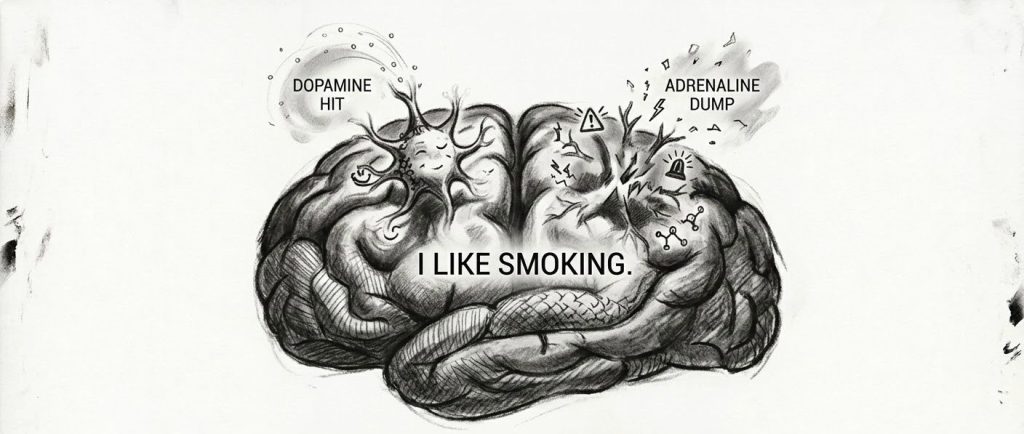
Many smokers feel incapable of quitting smoking because they believe they simply ‘like it.’ But what if the secret lies deep in your brain’s chemistry? Let’s look at what your neurons, Santiago and Ramón, have to say about your habit:
We all have that one book that vanishes from sight, only to reappear one day like an act of accidental magic. It shows up covered in dust, its pages yellowing, as if in a desperate plea for attention: «HEY! Someone read me, please! I don’t want to end up in the recycling bin without being read at least once! I don’t want to go out like this!»
That’s how, several weeks after meeting your friend, the book he gave you to help you quit smoking suddenly reappears. It was in the exact same spot where you left it, but all this time you didn’t even notice it, as if it had become invisible. Now, all of a sudden, it catches your eye again.
You walk over, pick it up, and give it a patronizing smile, remembering your friend’s face when he gave it to you. Then, you light a cigarette. You appreciate the gesture, really, but the truth is…
«I like smoking.»
The Science Behind Why You Feel Incapable of Quitting Smoking
The moment that thought crosses your mind, Santiago—a neuron in the locus accumbens, the area of your brain responsible for managing pleasure—explodes in a fit of rage:
«I like smoking, I like smoking! Give me a break! Ramón, did you hear what the Big Boss upstairs is thinking?»
«Of course I did,» replies Ramón, a neuron from another section of the brain. «Those guys only perceive what they want to perceive, and then we’re the ones who have to pay the price, one way or another.»
«I’m so sick of the same old song… ‘I like it, I like it,'» Santiago says in a mocking voice. «We like lots of things! We have a favorite food, a favorite song, sex…»
«Favorite?»
«Okay, maybe not ‘favorite,’ but always welcome. Sex is always welcome. And that produces pleasure—actual orgasms of pleasure!»
«Yeah, and just because it feels that good doesn’t mean we want an orgasm every waking hour of the day.»
«Well, ‘wanting’ is one thing…» Santiago tries to correct him.
«You want it because you don’t have it, but once you’re satisfied, do you want another one immediately? And again? Every single day for the rest of your life? Huh? Do you?»
«Alright, alright… I get it. Erotic dreams and movies are one thing, but that kind of behavior is unrealistic, impossible, and dysfunctional. You’re right.»
At that moment, Santiago gets spooked as he detects Ramón’s growing irritability. He can’t help it; as a neuron in the locus coeruleus, his job is to secrete adrenaline at the slightest hint of an alarm.
After years of smoking, the nicotine dependence created in your brain means that when levels start to drop, the neurons in this area begin to pump out an exaggerated amount of this hormone compared to a non-smoker, creating withdrawal symptoms.
This reaction varies wildly—from person to person and from moment to moment. And today, even though you just finished a cigarette, you can’t help but light a second one. You don’t want it; you need it.
Once the smoke is inhaled, it takes only seven seconds for the nicotine to hit the brain. In this part of the process, Ramón is the one having a blast. As a neuron in the locus accumbens, the stimulation of his receptors by the nicotine causes him to secrete dopamine, triggering a sensation of pleasure and happiness.
«Feeling better, Ramón?»
«Oh yeah… this dopamine hit feels incredible…» he whimpers. «Now let’s see how long I can go before I start dumping adrenaline again. It’s exactly what we were talking about, damn it! We have a favorite food, but we don’t need to eat it for breakfast, lunch, and dinner every day—we’d get sick of it! We have a favorite song, but we don’t listen to it 24/7… So the Big Boss shouldn’t be telling me we smoke because we ‘like’ it. When you do something every single day, multiple times a day, that’s not ‘liking’ it. That’s a necessity. That’s dependence… no matter how much momentary pleasure it brings, right?»
But of course, you aren’t aware of this conversation. These complaints rarely reach the «Command Center» of your conscious thought. That’s why, satisfied after your second cigarette in a row, you look at the book and think:
- Maybe quitting smoking would be a good idea!
- Okay, I really do smoke out of necessity, not for pleasure, but I’m incapable of quitting.
- I’m satisfied now, and from this state of calm, I still say I smoke because I like it, not because I need to.
- If part of you still enjoys it, maybe it’s worth seeing how this all really starts.